
What is basis (the basis differential) in agribusiness — and why it matters so much
Every morning, producers and analysts watch the exchange — Chicago (CBOT) or B3 — to know "where soybeans are trading". But the exchange price is almost never the price the producer actually gets at the farm gate. That gap has a name: basis, or the basis differential.
What is basis (the basis differential)?
Basis is the difference between the local cash price in your region and the futures reference price on the exchange. It is the link between the "paper" world (futures contracts) and the real world (the grain on your farm or at the port).
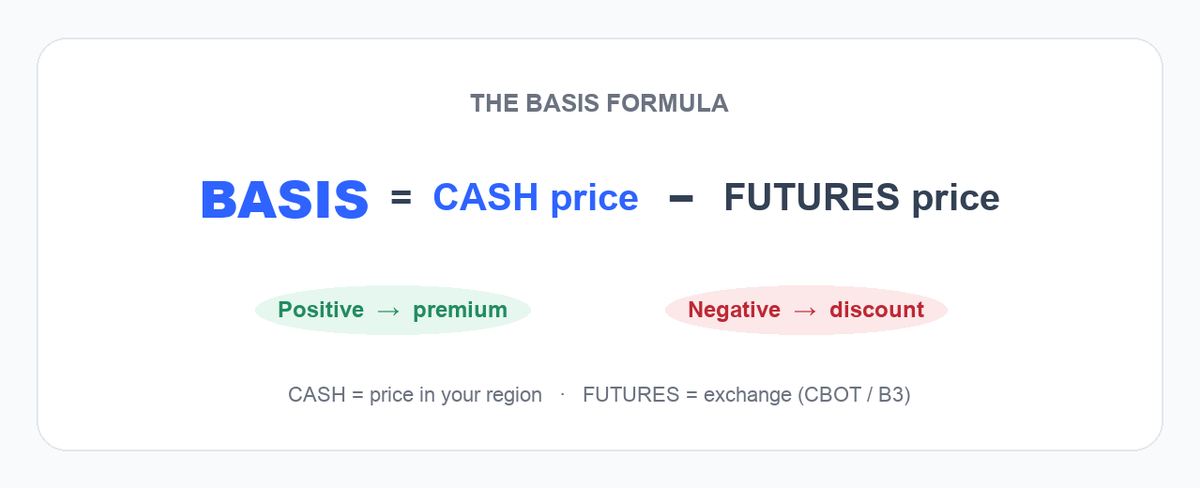
In numbers: if the exchange (converted to local currency per bag) is at R$ 120 and the cash price in your region pays R$ 126, the basis is +R$ 6. If cash pays R$ 114, the basis is −R$ 6.
Premium and discount: reading the sign
The sign of the basis already tells the story:
- Positive basis (premium): cash is worth more than futures — usually strong local demand or tight supply.
- Negative basis (discount): cash is worth less than futures — heavy local supply (harvest coming in) or expensive logistics to the destination.
In practice: a "strong basis" means a premium (or a smaller discount); a "weak basis" means a discount (or a smaller premium).
Why does basis exist?
The exchange is a global, standardized reference; your grain has a place, a date and a quality. Basis comes precisely from those differences:
- Freight and logistics to the port or processor.
- Local supply and demand — how much grain is in your region right now.
- Quality and grade of the product.
- FX, since the Chicago exchange is quoted in US dollars.
- Export premium — in Brazil, the FOB-port basis (e.g., soybeans FOB Paranaguá) is the main reference.
- Storage and seasonality — during harvest (February to May), the supply glut tends to weaken the basis.
Futures × cash: a visual example
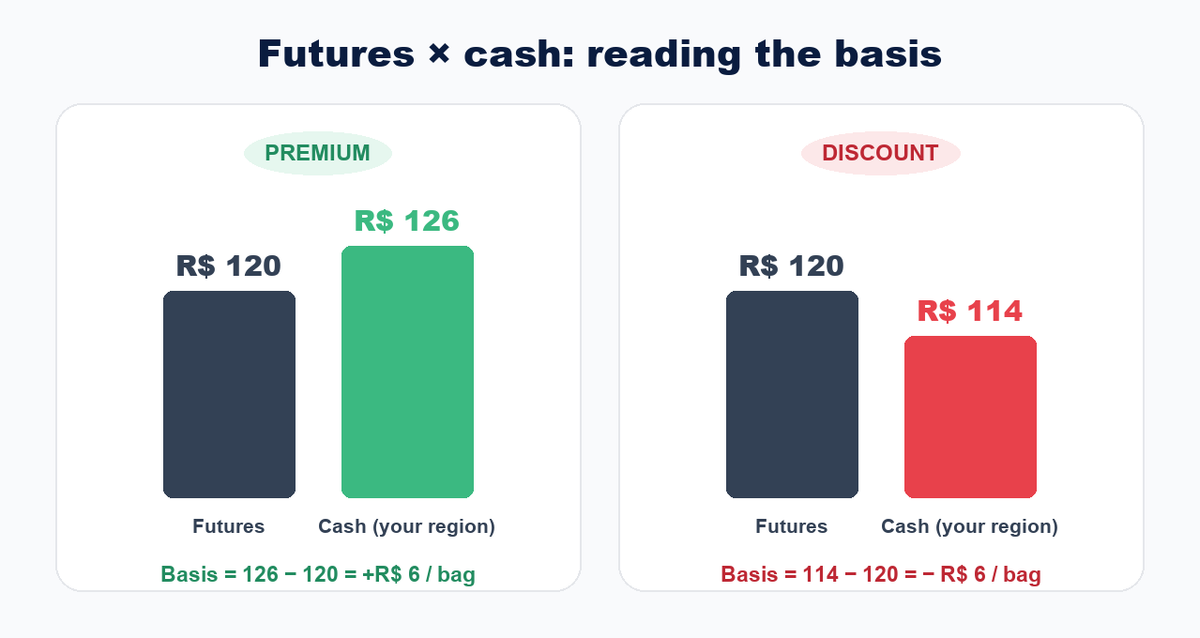
In the example, futures are at R$ 120/bag. In a region with strong demand, cash pays R$ 126 — a R$ 6 premium. In another, at the peak of harvest, cash sits at R$ 114 — a R$ 6 discount. Same exchange, different basis.
A producer's day-to-day
For the grower, basis answers a practical question: where and when do I sell best? Two regions can share the same futures price yet pay different cash prices — the difference is the basis.
Tracking basis helps to compare buyers and regions, spot when the local premium is strong (a good time to sell cash), and separate what is an "exchange" move from what is a "your region" move.
A trader's and analyst's day-to-day
For origination and trading, basis is raw material for decisions: it is how you buy in the right region, arbitrage between locations and build the hedge — lock the price on the exchange and manage the local basis separately.
Basis is also a thermometer: a rising basis tells a story of local demand or scarcity that the exchange screen, on its own, does not show.
Spot basis × forward basis (“locking the basis”)
There is spot basis — immediate delivery, grain ready — and forward basis, negotiated today for delivery months ahead.
That is where locking the basis (or a "basis contract") comes from: pricing happens in two steps.
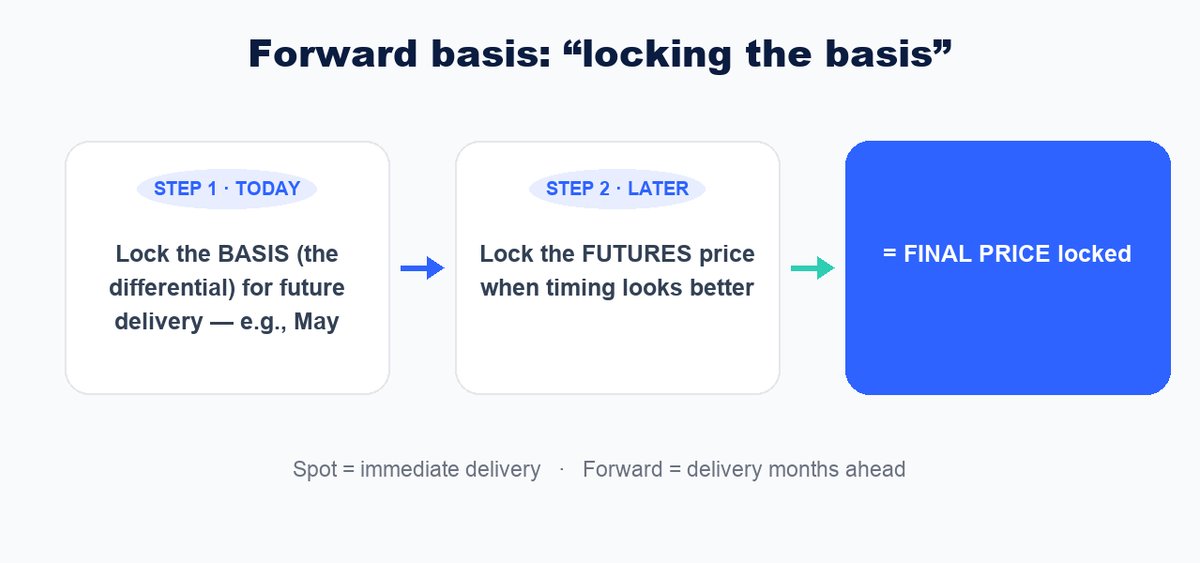
First the producer locks the basis (the differential) for a future delivery; then locks the futures when timing looks better. The sum of both legs is the final price. This lets you lock part of the price without deciding everything at once.
Why basis matters
Because the price you receive is not just the exchange — it is the exchange plus (or minus) the basis. Understanding basis is what separates "checking the quote" from deciding with strategy: when to sell, where to sell and how to protect the price.
Quick glossary
- Basis / basis differential: local cash − futures (exchange).
- Premium: positive basis (cash above futures).
- Discount: negative basis (cash below futures).
- Strong / weak basis: differential more / less favorable to the seller.
- Locking the basis: fix the differential now and the futures later (two-step pricing).
- FOB: price at the port/origin, excluding onward freight.
Further reading
Reference materials: StoneX / Mercados Agrícolas, Hedgepoint, B3 and CME Group.
Sapiens Agro tracks prices, premiums and basis in real time to support your marketing decisions. Explore Agrosap and Sapiens Freight.